Walk Mission Street on a Thursday evening this month and you'll pass two buildings that tell opposite stories about the same 400 feet of sidewalk. One has changed its name three times in recent memory. The other has held the same trade, in the same brick, since a man named Alexander Graham cleared a eucalyptus grove to build it. Both are doing fine business right now. That's the part worth sitting with, because it means the "new restaurant" story everyone tells about a changing downtown is only half true here. The other half is a stretch of storefronts that hasn't budged in over a century.
Start at 1010 Mission Street, inside the building longtime locals still call the Edwards & Faw building. This address has cycled through Piccolo, then Crossings, and now houses Cannonball, a bistro from James Beard Award winner Matt Molina and his business partner Joe Capella. Molina won Best Chef: Pacific in 2012 for his work at Osteria Mozza, and Capella has spent more than a decade opening restaurants across the east side, including Everson Royce Bar. When the two went looking for a space, they found exposed brick and dark wood floors already doing half the design work for them. Capella has described the interior's original character as making the space "look and feel like a restaurant" before they touched a wall. They brought in Fettle Design to lean into that instinct, aiming for something between a London wine bar and a New York bistro.
One address over, at 1020 Mission Street, a different kind of new occupies the same block. Visionarium Live Italian runs a rooftop surrounded by Mediterranean plantings, pours more than a hundred wines, and treats a Tuesday night the same way it treats a Saturday, with live music and rotating cultural programming built into the regular calendar rather than saved for special occasions. It's a concept that assumes people will come back weekly, not just once for the opening.
That's two ambitious new restaurants within a hundred feet of each other. If you only read the openings, you'd assume Mission Street is in the middle of a full turnover. Walk another ninety feet and you'd learn otherwise.
The Block That Hasn't Changed Its Mind Since 1906
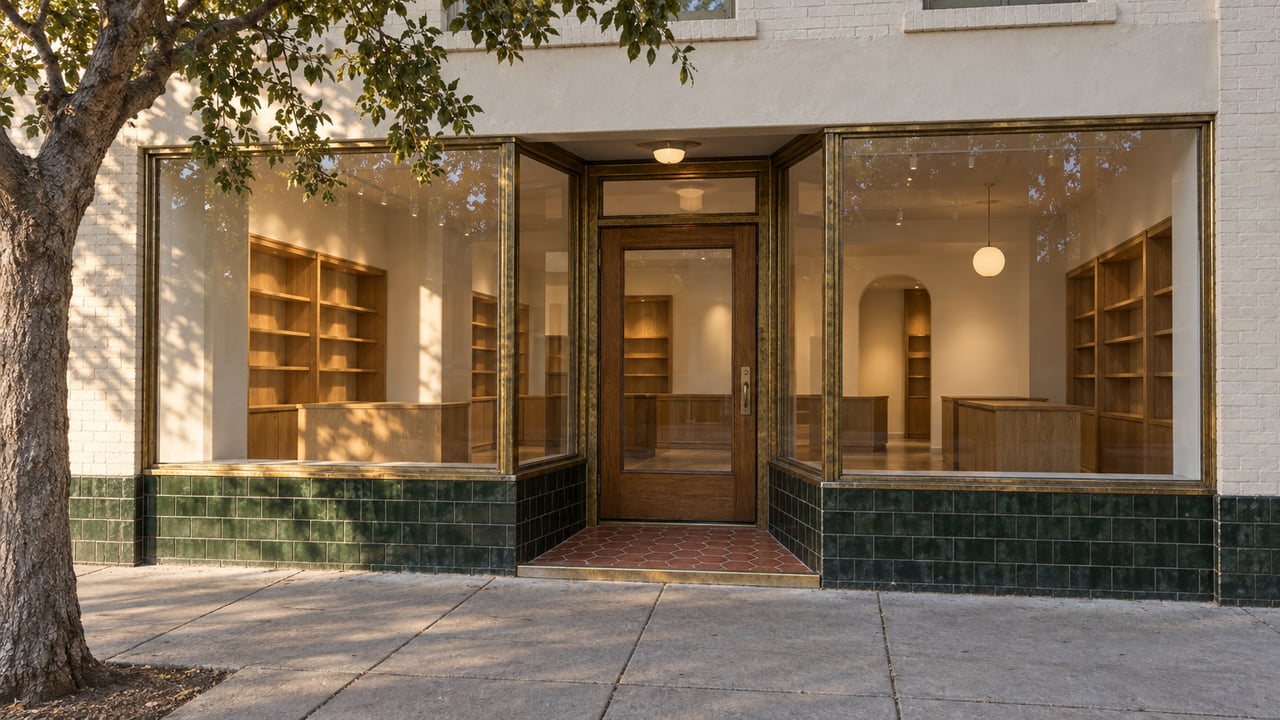
Between Diamond and Meridian Avenues sits a set of three connected storefronts locals call the Graham Block, and it is the quiet argument against the turnover story. Alexander R. Graham built the first of these, the Alexander Building at 1001-1005 Mission, in 1906, after clearing the eucalyptus grove that stood there before him. A local newspaper reported in November 1907 that every store in the building was rented, open, and doing business. That building has held a continuous commercial identity since it first appeared in the city directory in 1909, and today it's where La Monarca Bakery & Cafe operates, with studio space and residents occupying the second floor exactly as the original design intended.
Two doors down, the First National Bank Building went up in 1908 at the Diamond Avenue end of the block, and the A.R. Graham Building filled the gap between the two in the same year, designed by architect Thornton Fitzhugh in a Renaissance Revival style. Today this same three-building stretch is home to Aro Restaurant alongside La Monarca. Same footprint, same brick, more than a century of continuous retail use.
Here's the comparison that actually matters, laid out address by address:
| Same Stretch of Mission Street | What's Changed | What Hasn't |
|---|---|---|
| 1010 Mission St | Piccolo, then Crossings, now Cannonball | The exposed brick and original wood floors, kept through every concept |
| 1020 Mission St | Now Visionarium Live Italian | Storefront footprint unchanged since it was built out for retail |
| 1001-1017 Mission St (Graham Block) | Tenant names have shifted over decades | Continuous commercial use since 1906-1909, now La Monarca and Aro |
Put those two columns next to each other and the picture sharpens. Mission Street isn't experiencing a wave of change. It's running two clocks at once, side by side, and they tick at different speeds depending on which building you're standing in front of.
Why Both Clocks Keep Working
The obvious question is why a corridor this small can support both a restaurant that reinvents itself every few years and a bakery that has occupied the same address since before Los Angeles had a decent freeway. Part of the answer is foot traffic that doesn't depend on any single tenant. Mike & Anne's Restaurant at 1040 Mission has built well over a thousand reviews on the strength of an unglamorous, dependable breakfast-through-dinner menu, the kind of place that doesn't need a design story to stay full. It sits between the fast clock and the slow clock without belonging fully to either, which is its own kind of proof that Mission Street has room for more than one operating model at a time.
The other part of the answer shows up every Thursday, whether or not you were planning to eat out. The South Pasadena Farmers Market has run continuously since 1999 and has been operated by the South Pasadena Chamber of Commerce since 2004, setting up right next to the Metro A Line's South Pasadena station on Meridian Avenue. Through fall, it keeps its 4 to 8 p.m. hours, shifting to 4 to 7 p.m. only once winter arrives. That weekly rhythm does something a single restaurant opening can't: it puts hundreds of households on this exact stretch of sidewalk on the same evening, every week, all year. A new concept a block away benefits from a night when the street is already full of people who came for produce and stayed for dinner. A hundred-year-old bakery benefits from the same crowd without needing to reinvent anything.
Reading the Street Correctly
None of this means every new restaurant on Mission Street is destined to last, or that every historic storefront is immune to a lease that doesn't get renewed. What it does mean is that the presence of a new restaurant next to a landmark that hasn't changed hands in decades isn't a contradiction. It's the actual mechanism keeping the corridor healthy. The Graham Block gives the street a floor. Cannonball and Visionarium give it a reason to keep showing up on a Wednesday instead of just a Thursday.
If you've lived here long enough to remember when 1010 Mission was still Crossings, the churn can feel unsettling in isolation. Looked at against the building ninety feet away that's held one trade since Theodore Roosevelt was in office, it reads differently. Mission Street isn't losing its identity to newer concepts. It's proving that its identity was never tied to any single tenant in the first place.
That's worth knowing the next time you're walking to the farmers market on a Thursday and notice another storefront has changed hands again. Check the building next to it first. There's a decent chance it hasn't moved in a hundred years, and that's exactly why the new place next door can afford to take a risk.
If you're weighing a move to a block like this one, or wondering what a home near a corridor with this kind of staying power is actually worth right now, The Berns Team knows Mission Street the way its longtime tenants do. Reach out for a conversation about South Pasadena, or start your 10 Day Blitz with a free home valuation.