Why does the marquee outside the Rialto Theatre still sit dark most nights while the sidewalk in front of it keeps filling up anyway? Anyone who's driven Fair Oaks Avenue after dark has probably wondered the same thing. The neon came back on in November 2020. The Egyptian-and-Spanish-Baroque facade got its restoration. And the theater has stayed a church ever since, with the two street-level storefronts beside its entrance still cycling through the same uncertain status they've held for years.
Meanwhile, one block over on Mission Street, nothing about that unresolved question seems to matter much. A plant shop opened there last summer. A vintage boutique keeps extending its hours because people keep showing up. An art space just moved to a bigger spot. None of that depended on the Rialto finishing anything.
The Block Doesn't Wait on the Marquee
The easy assumption about a small downtown is that its anchor institution sets the tempo. Fix the landmark, and the street around it follows. South Pasadena's Mission Street corridor argues the opposite. Its energy comes from something far less dramatic than a restored movie palace: a farmers market that has run every single Thursday since 1999, through recessions, a pandemic, and every stretch of storefront vacancy in between.
That market is why new retail keeps testing Mission Street even while the neighborhood's grandest building stays in limbo. Foot traffic doesn't need a lit marquee. It needs a reliable reason to show up on a specific day, at a specific time, every week, for long enough that showing up stops being a decision and starts being a habit.
What's Actually Filling In Along Mission Street
The turnover on this stretch has been steady enough recently that it's worth naming what's new, because the pattern matters more than any single opening:
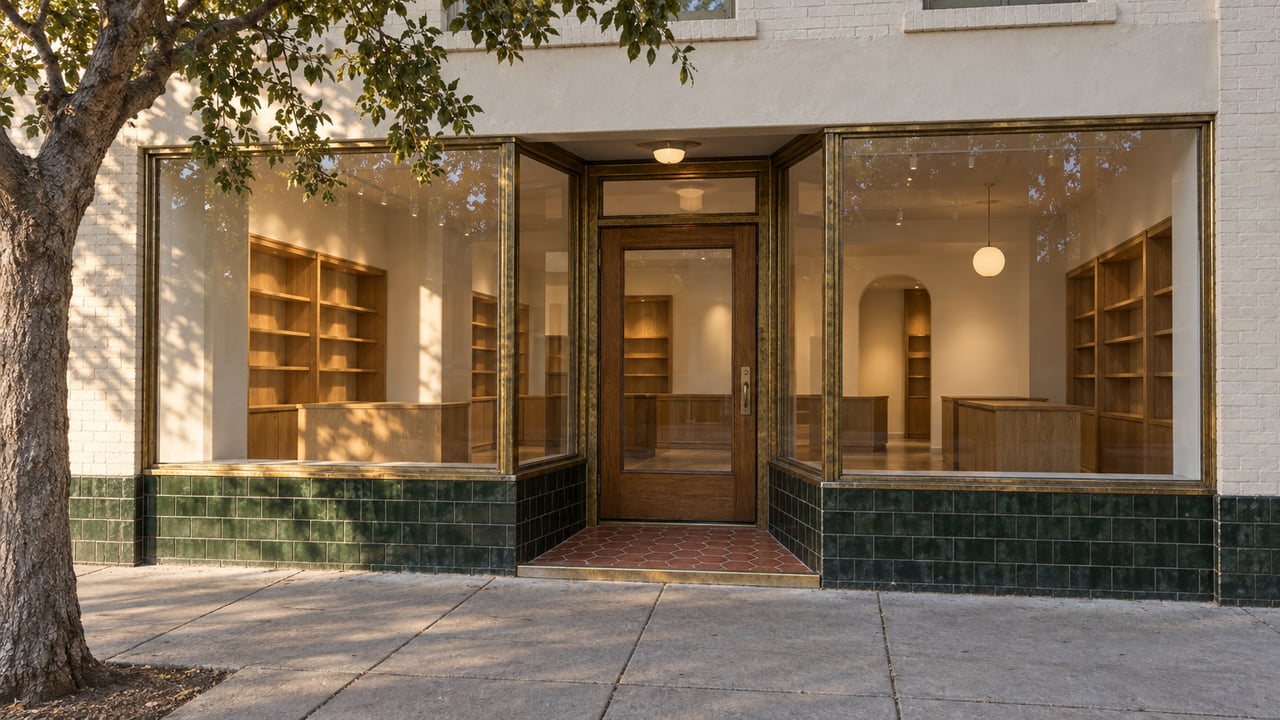
- Mission Gardens, a plant shop at 1026 Mission Street, held its ribbon cutting last summer with three city councilmembers on hand, evidence that the city treats even a small retail opening as worth showing up for.
- The Hive, a longtime art and community space, relocated to a larger spot at 1118 Mission Street rather than leaving the corridor.
- Hotbox Vintage, the block's curated vintage boutique, has been extending its summer hours and hosting evening events, including an art show and market last fall, because there's enough evening foot traffic on Mission Street to justify staying open later.
None of these are the kind of national chain openings that show up in a retail report. They're small, independently run, and clustered within a few hundred feet of each other. That clustering is the tell. Businesses don't bunch up on a block out of coincidence. They bunch up where the traffic already exists.
Twenty-Six Years of Thursdays
The traffic exists because of the market. The South Pasadena Farmers Market sets up every Thursday afternoon at Meridian Avenue and El Centro Street, right beside the Metro A Line station (the same rail line most people still call the Gold Line), and runs from 4 to 8 p.m. in spring, summer, and fall. It has operated continuously since 1999 under the South Pasadena Chamber of Commerce, skipping only Thanksgiving. Regulars have described the surrounding streets closing to traffic on market afternoons because the crowd needs the space.
A few doors down, Nicole's, a French café, stays open until 7:30 on market nights specifically to catch that crowd once the produce stalls start packing up. That's a small business making a scheduling decision around a twenty-six-year-old institution's exact hours. It's the clearest evidence available that the market isn't just a Thursday event. It's infrastructure the rest of the block plans around.
The city leaned on that same infrastructure this spring when it merged its long-running Spring Arts Crawl with the Eclectic Music Festival into a single expanded event on April 25. The combined event took over Mission Street from Fair Oaks Avenue to Meridian Avenue for seven hours, with the Rotary Club running a stage at Mission and Meridian and a second stage further down the block booking Raul Pacheco, the founder of Ozomatli, for a solo debut. A street built around one weekly market handled a full afternoon-into-night festival on the same footprint without needing a single new anchor tenant to make it work.
The Theater Everyone Still Drives Past
The Rialto is the one piece of Mission Street's neighbor corridor that hasn't followed the same pattern, and its story explains why patience with it runs so deep. Built in 1925 by architect Lewis Arthur Smith, the same designer behind the Vista Theatre in Los Feliz, the Rialto seated 1,200 people across its orchestra level and balcony and earned a spot on the National Register of Historic Places in 1978, back when South Pasadena residents circulated petitions to stop it from becoming a parking lot. It closed as a movie house in 2007. Developer Izek Shomof bought it in December 2014, and since 2017 it's been leased to Mosaic, a non-denominational, multi-site church, a tenancy that's now going on nine years.
The restoration split responsibility down the middle: Shomof's side handled the exterior, Mosaic handled the interior. The scaffolding around the facade came down in June 2020, and new neon went up on the marquee and vertical sign that November, six years ago now. As of the most recent public restoration update, the two ground-floor storefronts flanking the entrance were still waiting on tenants, pending decisions the owner hadn't yet made.
Escott Norton, a longtime consultant on the project and founder of Friends of the Rialto, put his own attachment to the building simply:
"From the very first time, I knew something was special about it."
That's the kind of devotion the Rialto still commands, decades after its last stage production and years into a restoration that's finished on the outside and unresolved on the inside. The Rialto's restoration is moving forward in stages, and Mission Street has kept adding tenants in the meantime, helped along by the Thursday afternoon that turns Meridian and El Centro into the busiest corner in the neighborhood, rain or shine, for going on three decades.
If you're weighing whether a corridor like this holds up over time, that's the number worth sitting with: a market that has run without interruption since 1999 says more about a street's staying power than any single building's timeline ever could.
If you're curious what else is shifting along Mission Street, from new storefronts to what a place near that corridor might be worth today, The Berns Team keeps close track of South Pasadena block by block.