By The Berns Team
Some Pasadena streets you drive through. Prospect Boulevard you slow down for. The century-old camphor trees close overhead into a green tunnel, the road bends instead of running straight, and one landmark home gives way to the next in a stretch few American neighborhoods can match. When buyers tell us they want real architecture and real history with their square footage, the Prospect Historic District is often where we begin.
Key Takeaways
- The Prospect Historic District spans roughly 69 acres and 108 homes across the Prospect Park and Arroyo Park tracts, listed on the National Register since 1983.
- Its streets hold work by Frank Lloyd Wright, Greene & Greene, Sylvanus Marston, Myron Hunt, and other leading architects.
- Curved, tree-lined boulevards and the 1908 Prospect Boulevard Bridge give the district a distinct, planned character.
- Homes here rarely come to market, and buyers prize their architectural pedigree and closeness to the Arroyo.
A Neighborhood Designed With Intention
Development began in 1904 on the Prospect Park Tract, when a group of investors divided a 32-acre parcel into wide, curving lots and planted the camphors and palms that still shade the street. The Arroyo Park Tract followed after 1910, and the two were joined by the graceful Prospect Boulevard Bridge in 1908. This was a planned enclave from the very beginning, not a piece of the standard Pasadena grid.
What gives the district its character
- Wide, curving streets laid out for the early automobile age, unusual for Pasadena at the time.
- A high canopy of mature camphor trees that arches over Prospect Boulevard.
- Clinker-brick and river-rock gateposts that announce the entrance from Orange Grove Boulevard.
- A setting beside the Arroyo Seco, with the Rose Bowl, Kidspace Museum, and Brookside Golf Course close by.
An Open-Air Museum of American Architecture
Few residential streets anywhere hold this concentration of landmark design. The district's most famous resident is Frank Lloyd Wright's Millard House, known as La Miniatura, his first textile-block house, completed in the early 1920s on a wooded ravine for rare-book dealer Alice Millard. Just down the road stands Greene & Greene's Louise C. Bentz House from 1906, the first home built in the tract. Beyond the district's edge, the Gamble House, which Dwell has profiled as one of the country's finest Craftsman homes, shows just how much architectural talent gathered in these few blocks.
Architects who left their mark here
- Frank Lloyd Wright, whose La Miniatura pioneered his patterned concrete-block building system in Southern California.
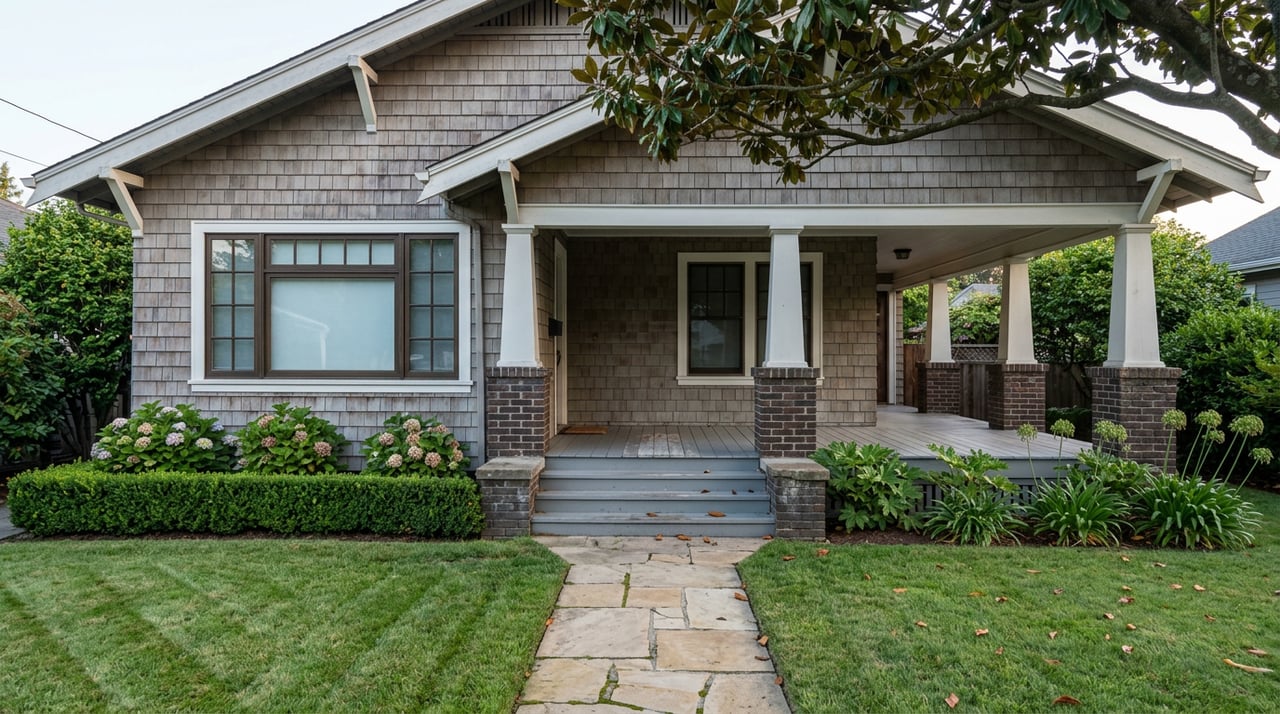
- Charles and Henry Greene, whose Bentz House is the district's finest early Craftsman bungalow.
- Sylvanus Marston and Myron Hunt, who contributed homes in Arts and Crafts and period-revival styles.
- A run of styles standing side by side, from textile-block modernism to English-inspired Arts and Crafts.
Living in the Prospect Historic District
Owning here means joining a community that takes preservation seriously, which brings both rewards and responsibilities. The protections that keep the streetscape intact also guide what owners can change, and Pasadena's Mills Act can offer meaningful property-tax relief to those who maintain a home's historic character.
What buyers should keep in mind
- Landmark-district status means exterior changes are reviewed to protect the historic streetscape.
- The Mills Act can reduce property taxes for qualifying owners who commit to preservation.
- Inventory is limited, and turnover is slow, so serious buyers benefit from strong local relationships.
- Generous lots, mature landscaping, and Arroyo proximity set many of these properties apart from newer Pasadena housing.
FAQs
Where is the Prospect Historic District in Pasadena?
It sits just north of Old Pasadena, centered on Prospect Boulevard between Orange Grove Boulevard and Westgate Street, near the Arroyo Seco. The entrance from Orange Grove is marked by its well-known gateposts.
What architectural styles will I find there?
A remarkable mix. The district includes Frank Lloyd Wright's textile-block La Miniatura, Greene & Greene Craftsman work, and homes in English Arts and Crafts and period-revival styles by architects like Sylvanus Marston and Myron Hunt.
Is it hard to buy a home in a Pasadena historic district?
Inventory is limited, and the homes are protected, so the process rewards patience and local knowledge. We help buyers understand landmark rules, the Mills Act, and how to be ready when the right home comes available.
Work With The Berns Team Today
The Prospect Historic District is one of those rare places where a walk down the street doubles as an architecture lesson. We know its homes, its history, and the rhythm of how properties come and go here, and we love sharing that knowledge with buyers and sellers alike.
If you're drawn to Pasadena's historic districts and the craftsmanship that defines them, reach out to us at The Berns Team. We'll help you find a home with a story worth telling.
If you're drawn to Pasadena's historic districts and the craftsmanship that defines them, reach out to us at The Berns Team. We'll help you find a home with a story worth telling.